Zittau - Refuge for Religious Refugees
 Zittau became, in the time of the violent counter-reformation (after 1621), a haven for Czech and German Protestants from the areas of the Bohemian Crown that wanted to preserve freedom of conscience for themselves and their descendants. On 18thJanuary 1623 the Elector of Saxony issued a decree to accept Czech religious refugees, who asked for asylum, in his country. Zittau was already crowded with refugees in April 1623. The city with 6,000 inhabitants had to cope with the arrival of thousands of refugees, which was not without problems. After Roman-Catholicism became the only allowed Christian denomination in Bohemia and Moravia (1627-1628) more and more waves of religious refugees resulted. In 1630, the Czech refugees established in the “Demuth House” (now Neustadt Nr.10) a separate prayer room in which they met for over sixty years. Later, the Czech prayer room was in the “Heffterbau” (now a part of the Zittau Museum).
Many of the exiles from the Czech lands and their descendants contributed to the cultural and economic development of the city (Christian Weise, Andreas Hammerschmiedt, Christian Pescheck, Christian Adolph Pescheck, Karl Gottlob Moráwek and others). For the persecuted Protestants in Bohemia Zittau was, until the publication of the Patent of Toleration (1781), a place of spiritual assistance. The preachers and editors of Czech books (Václav Trojan, Daniel Stránský, Kašpar Motěšický, Václav Kleych and others) brought to them from there - often risking their own lives - strength and hope.
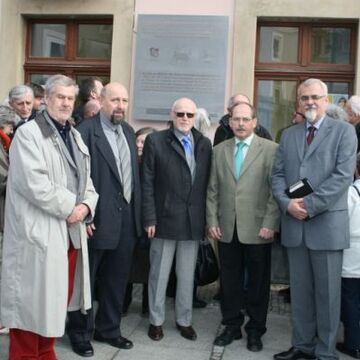
The association Exulant ('Religious Refugee') and the town of Zittau have decided, with the support of the “Small Projects Fund” of the Euro Region Nisa, to remember these historical ties in the field for the struggle for freedom and human dignity between Czechs and Germans with a plaque on the house where the first prayer hall of the Czech refugees in Zittau was. The new monument, whose creator is the painter Jan Měšťan, was unveiled on Saturday 03.08.2014 by Moderator Joel Ruml and the Mayor of Zittau, Arnd Voigt. It was nice that on this occasion a large community of members and non-members of the association Exulant came together - from the Czech side came Bohemian Brethren, Baptists, members of the Moravian Church Presbytery, from the German side Lutherans from Zittau and members of the Moravian Church in Herrnhut and also from both sides people who don't fit into any of the above boxes. There were lectures by the historian Edit Štěříková and the Head of the Zittau Museum, Marius Winzeler, about the eventful history of the refugees in Zittau and about their contribution to the city and the Lausitz region. Choirs from the Evangelical Church of Czech Brethren and the Baptist Unity of Brethren in Liberec sang and a brass ensemble of the Zittau Lutherans played.
Karl Gottlob Moráwek, a descendant of Czech refugees, said in the 19th century that the Czech language was almost gone from Zittau and soon there would come a time when the citizens of Zittau would know nothing anymore about the religious refugees. Now, in the 21st century, we can say that this time has not yet come.
Jan Bistranin
13.2.2014 - Zittau - Refuge for Religious Refugees