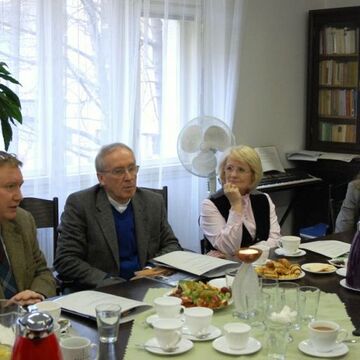
Visitors from Scotland
 On 1 February 2013 the ECCB welcomed visitors from the Church of Scotland. The two Churches have worked together for many years and this meeting was, in part, a celebration of that partnership. The ECCB hosted four visitors: The Very Rev Albert Bogle, Moderator of the General Assembly of the Church of Scotland, and his wife Mrs Martha Bogle; Rev Susan Brown, Minister of Dornoch Cathedral & Chaplain to the Queen in Scotland; and Rev Ian Alexander, General Secretary, World Mission Council, Church of Scotland. After a devotion given by ECCB Moderator Rev. Joel Ruml we went on to introductions. In addition to those named above other participants included; the Rev. Gerhard Frey-Reininghaus, head of the Ecumenical Department of the ECCB, and other members of that department including Daniela Hamrová and me as the PCUSA Mission Coworker. We were also joined by others from the Central Church Office including; Lia Valková Lay Moderator, Martin Kocanda Head of the Central Office, and Daniela Ženatá Chief Editor of Česky Bratr. Rev. Štěpán Janča, pastor in Orlova also joined us since his congregation has a partnership with a congregation in Scotland.
Moderator Bogle presented some of the crucial issues facing the Church of Scotland and Scottish society in general. One major issue is the economic depression in Scotland which is a phenomena affecting most of the world. Another issue centered around the discussion about Scottish Independence. Moderator Bogle expressed his belief that the Church must comment on issues relevant to society as a whole and present the message of the Gospel. He urged us to talk about Jesus more and the Church less. Moderator Ruml went on to share some of the issues facing the ECCB. Since the ECCB is a minority church is doesn’t have a voice in society in the same way that the Church of Scotland does. One challenging trend in the Czech Republic is the growing number of people who support the ideals of Communism. Moderator Ruml also thinks that a central issue here in the Czech Republic is a general sense of passivity.
After discussing some of the general issues facing the two Churches the conversation turned to ways in which the two Churches could continue to cooperate. In addition to the congregational partnerships it is hoped that other ways of cooperation can be found. One staff member from the Ecumenical Department of the ECCB, Daniela Hamrová, will be taking an intensive English course in Scotland for a month. In addition to financial support the Church of Scotland will provide hospitality. There is also the hope that clergy in the Czech Republic and Scotland can participate in events in both countries. Perhaps the two churches can work together in areas of shared concern such as work with the Church in Cuba and involvement in the Middle East. It was exciting to witness the energy and enthusiasm for this deepening relationship. As a clergy person in the PCUSA, our denomination is deeply indebted to the Church of Scotland, it was also exciting for me to interact with this delegation and to witness the longstanding relationship between the ECCB and the Church of Scotland. As is often the custom here, and in most parts of the world, our time together concluded with a shared lunch before the delegation boarded a train to spend the weekend in the congregation in Orlova.
Rev. Dr. Karen R. Moritz
PCUSA Mission Coworker
6.2.2013 - Visitors from Scotland