Visiting the Lusatian Sorbs in Bautzen
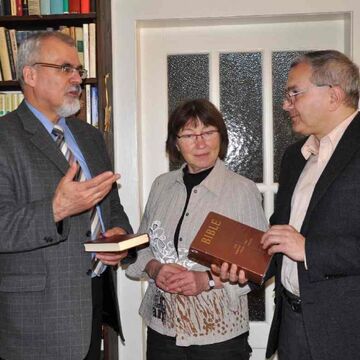
 Four representatives of the Evangelical Church of Czech Brethren met in Bautzen (Germany) with Jan Malink, pastor of one of the ten parishes in which Sorbian-German church services take place, and Trudla Malinkowa, the chief editor of the magazine of the Protestant Sorbs 'Pomhaj Boh'. Moderator Joel Ruml, lay moderator Lia Valkova, synod council member Pavel Stolař and the head of the department for ecumenical relationships, Gerhard Frey-Reininghaus, visited the Rev. and Mrs.Malinek on their way to Berlin in late March.
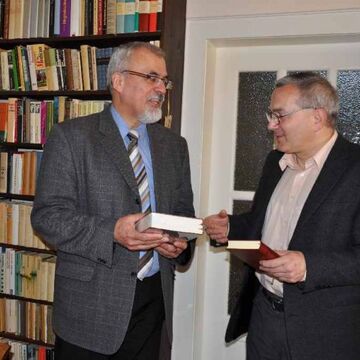
Although the meeting took place on German territory, and the protestant Sorbs belong either to the Lutheran Church in Saxony (EVLKS) or to the Evangelical Church Berlin-Brandenburg-Silesian Upper Lusatia (EKBO), Czech and Sorbian were spoken the whole time. In a pleasant atmosphere, in the living room of the family Malinek, discussions were held concerning the development of closer links between parishes in the Upper and Lower Lusatia and Czech Protestants. Suggestions involved mutual cooperation regarding the support of students, the exchange of church magazines and the organization of frequent and personal meetings. The moderator received from Rev.Malinek a Sorbian-protestant hymnal entitled 'Spěwarske za ewangelskich Serbow' and dedicated with 'Bohu k česči a Serbam k wužitku'. Something that every Czech will understand.
The Lusatian Sorbs are a numerically small western Slavic people who inhabit the south-eastern part of east Germany with the historic name of Lusatia. They use two independent written languages: Upper Sorbian and Lower Sorbian. From the 14th Century until 1635, Lusatia belonged to the Czech crown. After the war, the Sorbs have been strongly supported from Prague (gymnasium, printers, radio broadcasts). In the communist era a large-scale network of Sorbian institutions was created. The price for this unique support in the history of the Sorbs was the full integration into communist-led structures. One of the first things foreigners notice are the bilingual names. The Sorbs have their own studio in the MDR (Central German Broadcasting) television. The right of the Sorbs is now established in the constitution of the Free State of Saxony. The Sorbian parishes are part of the EVLKS or the EKBO and approximately ten bi-lingual Sorbian-German services are held. The use of Sorbian as a living language by the population is diminishing, but tradition and culture are still preserved.
gfr/ DaZ
2.5.2012 - Visiting the Lusatian Sorbs in Bautzen