Thoughts on the occasion of the anniversary of the synagogue fires during the Kristallnacht
 In November last year the world commemorated, for the 75th time, the Kristallnacht, which derives its name from the shards of shattered windows of Jewish businesses and synagogues. From 9thto 10th November an organized attack on the Jews took place in Germany, in Austria and in the Sudeten areas that were then already annexed to the Reich. Dozens of synagogues were destroyed and went up in flames, hundreds of shops were looted. Nearly a hundred people died and in the following days thirty thousand Jews were deported to concentration camps. The pretext for this pogrom was the assassination of the Secretary of the German Embassy in Paris, Ernst von Rath, by the Jew Herschel Grynszpan.
A church service and a reverent funeral
We commemorated this sad event in Česká Lípa with a joint service which included the participation of representatives of Christian Churches and of the Jewish communities of Dečín and Liberec. The assembly was held at a nearby church where we heard, amongst other things, words about bullying. The minister pointed out, that the way from harmless bullying to pogroms does not have to be long and concerns each individual and the whole nation. The reverent obsequies, where once the synagogue stood, were led by cantor Ivan Kohout and the Chairman of the Jewish community, Mr. Vladimír Poskočil from Děčín, who also gave the speech. I was pleased, that one of the organizers of a similar event in nearby Zittau, where all that remains of the synagogue is a plaque and a vacant lot, also came, following our invitation, to Česká Lípa.
A twice burnt synagogue and a rescued one
Today, probably nobody in Česká Lípa confesses the Jewish faith and the community, which numbered about 400 members before the war, no longer exist. Most did not survive the Holocaust and after the war several dozen returnees have gone to Israel or to other parts of the world. That they didn't find a welcome here is also connected to the fact that they spoke mostly German and that the Communist regime didn't look kindly on "Zionists". The only reminder of the monumental synagogue from the 19th century is a small plaque on a large parking lot and a street name in a former Jewish quarter, which has, however, also perished in the years of socialist reconstruction. The historian Ladislav Šmejkal was also reminded of the absurdity of the events when he pointed out that the synagogue was set on fire twice. The first fire was extinguished by uninformed firefighters. The second time they received instructions and only protected the surrounding buildings. Hardly a synagogue in Northern Bohemia escaped destruction. The only exception is in the city of Děčín. Here the synagogue is situated near the Protestant church in a relatively densely built-up area and on a hard to reach hillside. This has probably - thanks to the intervention of the German mayor of the city - contributed to the rescue of the object. The mayor fearfully argued that a fire could spread to the surrounding buildings.
A visit to nearby Děčín
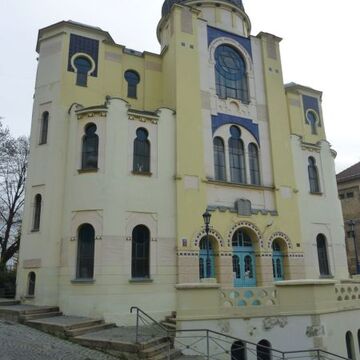
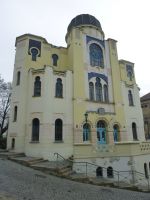
The synagogue, built in oriental style, is really very beautiful. Its dome is reminiscent of the only surviving building by a Czech architect in Hiroshima. In the city there is also a Jewish community and the synagogue is used both for worship as well as a cultural center. We were able to personally experience the kindness of the local community during two visits - first when it came to the preparations for the event in Česká Lípa, later at a Hanukkah celebration to which we were invited by the people of Děčín after the memorial service in Česká Lípa. The Hanukkah candles and the temporal proximity to the Christian Advent are the only things that connect these two festivals (except, of course, the belief in the common God, the LORD). Also the service, preceded by the rehearsal of traditional dances, was very different from a Christian service, it was somewhat oriental and emotional. However, it only took about half an hour, which can be inspirational :-) Then came the hospitality. Whether or not it was "kosher", I do not know. The community in Děčín is known for its liberalism and the participation of Christians didn't bother anyone. I hope that it was not our last visit.
A different House of Worship
The word synagogue comes from the Greek 'synagogein' - Assembly. Hebrew uses the words 'Bejt ha-kneset' (meeting house, also an expression for the Parliament). I think that "assembly" does not only have to be a term for a vibrant community. Religious buildings are built both for worship and for mutual encounter. Both are unfinished - both the human effort to celebrate the Lord with beautiful architecture and to bring something of this other dimension into being, as well as the assembly of the congregation in which there are often difficult relationships between imperfect human beings. Cemeteries were created around medieval churches and so created a gathering of the living and the dead. Today’s synagogues often only remember the dead. If they have survived, they rarely function today like the lively community in Děčín. Some serve Christians as a meeting place, others as a museum or another purpose. Probably the only modern synagogue in our country - also in Northern Bohemia - is located in Liberec. However, this is a new building which is part of the bustling county library center. In Česká Lípa, or in other smaller towns, a new synagogue will probably never again be built. But, it is meaningful to remember the gathering of the living and the dead. The ways to do this can be different.
Jan Kirschner, Photo: Author and reproduction by the Museum Česká Lípa
3.5.2014 - Thoughts on the occasion of the anniversary of the synagogue fires during the Kristallnacht