Staying near the family in old age Sheltered housing in Nosislav
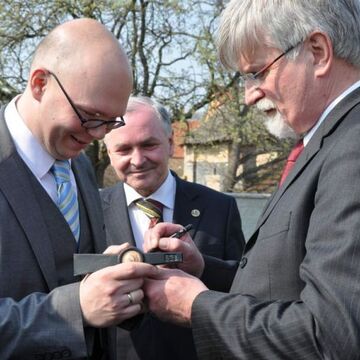
 People who lose their independence often have to leave their own home and move to a remote retirement home. Now there seems to be hope in Nosislav that they can remain closer to home. On 21st April this year, the cornerstone for a Sheltered Housing project was laid, a joint project of the parish of Nosislav and the Diakonia Centre in Brno. Not far from the place, where a hundred years ago a Protestant orphanage stood, a house is being built in which seniors and people with physical disabilities (eg after a stroke) will find a home. We talked with the pastor of Nosislav, Ondřej Macek, about how this idea came about, why a parish should get involved in diaconal work and what “home” means for him.
Where did the idea to build a diaconal facility in Nosislav come from?
Several people in our community had already discussed this for some time before I came to Nosislav. In the beginning we thought of our older sisters and brothers, our neighbors. I know that we cannot help everyone, but if we can at least alleviate some of the distress they experience the moment they are in need of support, or address the difficulties their children have who need to decide between career and care for their parents, that would be great.
The preparations lasted more than two years. During this time a group of people was formed in the parish, who together considered, formulated, fine tuned concepts and invited various experts. The young architect Petr Dobrovolný was involved from the beginning. In his thesis he had already dealt with the topic “housing for seniors”. Over time we also invited the director of the Brno Diakonia, Jan Soběslav, to the group. And in the end the idea was developed to build a small house on the grounds behind our church building (in accordance with current professional experiences) which will provide sheltered housing for seniors and people over 40 with physical disabilities (ie, mainly after car accidents). At the same time a care service will be set up for those who can still live at home, which is obviously the best.
What happened next?
A marathon of project preparation began; from agreements with the neighbors and the obtaining of various permits and especially finding funds, without which probably nothing works today. In that respect we have been very lucky: The Regional Operational Program South-East had just issued a request for tenders to support construction projects of this kind and we were successful in the application process. On 21st April of this year the cornerstone was laid. We got pledges of 18 million crowns, if the European Union does not go bankrupt. However we (ie: the Diakonia Centre in Brno which is organizing the entire project) need to raise 3 million crowns ourselves. This is an unimaginable sum for us. But we will try. And, therefore, we are very grateful for this years' Church wide collection during Pentecost. Thank you!
What does the parish say?
During the Council of Elders meetings we have told each other that we are a pretty vibrant community and, therefore, we should cease to revolve only around our own concerns, stop focusing on the painting of gutters and the usual parish maintenance work, but that we should somehow also live our Christian faith practically and differently. The parish was faced with the choice either to let the plot lie idle or to sell it over time as building land, to earn some money from it and gradually "eat up" the resulting profits or to do something completely different with it. And so they chose the sheltered housing project. This has a tradition in Nosislav. Our parish centre (the Hus-House) was originally a Protestant orphanage. By the way, when we complain that we live in a time of recession and that we lack willing donors, it is important to remember that the orphanage in Nosislav, with considerable support of the parish, operated during and after World War II.
Does the wider parish agree? Was it necessary to convince people?
I think, on the whole, yes. The parish stands behind this. We can’t quite imagine how it will work one day, what it will mean. Even I can’t quite imagine it yet. Sometimes someone asks: What will we get out of this? Similar to the disciples that once asked Jesus: "Then what will there be for us?" (Mt 19:27). Jesus' answer has two parts: He promises the disciples a future in his kingdom (and that is worth it for us, isn't it?). And then he acknowledges that it is not easy to live his way, that it is often necessary to give up and to sacrifice something, to leave things behind, but also that a person often gains something: new friends, gratitude, joy, a smile. The most serious objection was that we might fail with the "ordinary" Christian service in our parish and still want to venture further. It is hard to answer this, even if it concerns a slightly different area and if we do get help from the Diakonia in those matters which we can't do ourselves.
The project is called: Let's build a home. What does home mean for you?
I have moved many times and only a few pictures and books connect me with the past. Home means for me: Alžbeta, the boys and Jaelka, privacy, the feeling of security, the opportunity, to a certain extent, "to shape one’s life at one’s own discretion".
In the context of the separation of Church and State, Churches and parishes are expecting a period of increased financial uncertainty. Is it right to embark now on a relatively large project, such as your diaconal facility?
It is difficult to say. The cornerstone for this project was taken from a wall that remains of a prayer room from the time of tolerance whose construction had begun in April 1783. Then the builders were decidedly worse off and had to prove themselves much more without grants and at a much greater risk. All that what we have overcome is the cost to many people of a lot of money, effort and time. It was necessary to overcome different depressing obstacles. I think that something like this is only possible if you are very convinced that it all makes sense, that it is a good thing to do. At the moment it looks like we could, at least partially, find qualified professionals in the ranks of the parish. Many of our sisters and brothers think of this work and are keen to support it financially. We are organizing, as fundraisers, various events (Christmas market, publication of a biblical devotional, wine for Diakonia, etc.). And perhaps there will come the day where there is no full-time post for a minister in Nosislav and it might be then possible for the pastor to find part-time employment within the sheltered housing project. It could also be, that part of the parish events, like Bible study or seniors' groups etc., will take place there. Caring for seniors is more and more important and perhaps this example of a small diaconal facility connected to the local parish, will show, over time, that it is a viable model also for other parishes.
Would you like to live one day in your “Home in Nosislav”?
I will not lie. I hope, like probably everyone else, that one day, not too early and not too late, I will just be “knocked out”. But man can't influence that. Then the ideal case, naturally, is to be surrounded by family. But in the wake of the fact that people move far away, have longer working hours, difficulties to find work - some decisions are particularly difficult to make. For me, as I said before, dignity is associated with privacy and the opportunity to influence what happens to me. We have tried to emphasize exactly this in our project. A relatively large private room and at the same time help (also when dealing with loneliness). Of course, time will tell whether we achieve that. Well, I hope they'll let me move in at some point ...
I wish you and your Sheltered Housing Project the protection of the Most High.
Questions by Lenka Ridzoňová
14.7.2013 - Staying near the family in old age Sheltered housing in Nosislav