A festive invitation
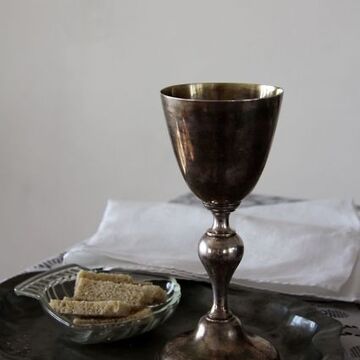
 This year it will be exactly 600 years ago that in some of Prague’s churches, which were under the influence of the reform movement led by John Hus, the administration of Communion in both kinds was reintroduced. This took place in the autumn of the year 1414, when John Hus had already been imprisoned in Konstanz. Jacob of Mies (Jakoubek ze Stříbra) and his associates in Prague restored the custom of administering Communion in both kinds – consecrated bread and wine for all participants – after almost 200 years. This happened in four of Prague’s churches: St. Martin in the Wall, St. Michael, St. Nicolas and in the Bethlehem Chapel.
Historical context
At that time there was no significant Reformation movement within the Church that reacted in such an expressive way to the errors and contradictions in the church doctrine and practice. The demand to permit the laity to receive bread and wine during the Eucharist became a fundamental symbol and motivator for the Hussite movement, in which all the important principles of the Reformation movement came together: Christ’s nearness to all who turn to him in faith, the anticipation of Christ’s imminent return, the return to the original simplicity of biblical Christianity, the dissatisfaction with the current state of „Christian“ community, the rejection of the abuse of authority by the church in order to gain wealth and power, and the need to lessen the differences between clergy and laity, rich and poor...
In this context the Hussite movement is still an extraordinary international and timeless phenomenon today. This is also reflected in the fact that its creative and spiritual strength has inspired people across Europe and that it has re-emerged in various ways throughout history.
Festivities on October 12th
Being part of the Protestant community in the Czech Republic, we would like to remember this significant anniversary on the 12th of October 2014, with an all-day celebration in the Bethlehem Chapel and at other locations that were in some part related to the events of those days – St. Martin in the Wall, St. Nicolas on the Old Town Square and in the building of the Evangelical Theological Faculty of Charles University.
The festivities will be opened with an ecumenical festive service, beginning at 10am in the Bethlehem Chapel.
In the second part, during the afternoon and evening, the program will be extended to other places, where different events will take place concurrently, such as; concerts (the united choir Jakoubek/Hieronymus, T. Najbrt, the „Spiritual kvintet“), a theatrical performance of V. Marčik, several lectures (J. Lášek, P. Hradilek and others), a panel discussion about social exclusion, a concert by a Roma group, workshops for children and adults, guided walks through Reformation Prague, an interactive game for children and the presentation of a new collective work on the church of St. Martin in the Wall.
Varied festivities
The principle underlying all of the celebrations is the ecumenical cooperation of those Czech churches that base themselves on the Hussite legacy and their effort to appeal to the wider public. The diocese of Prague of the Czechoslovak Hussite Church also plays a significant part in the preparation of the festivities, in collaboration with our Church (ECCB). The organisers also make an effort to work closely with the Presbytery of the Church of the Brethren in Prague.
By no means would we want to leave the social dimension connected to the event unmentioned. The administration of Communion in both kinds had a big social impact at the time. All people - clergy and laity, rich and poor, powerful and humble - are equal in the eyes of God.
Foreign friends are also invited to take part in the celebrations. For example, the children’s service in the opening worship service will be held by the German speaking evangelical community, who currently worship at the Church of St. Martin in the Wall.
We invite the entire church!
The organizers (the Prague Presbytery of the ECCB in collaboration with the Synodal Council, the Central Church Office and ecumenical partners) offer all Protestant communities the possibility to take part in the festivities in three ways.
- Personal attendance on 12 October in Prague. About half of the communities of the Prague Presbytery will not hold their own worship service on that day, but will participate in the festival service in the Bethlehem Chapel.
- Festive service with communion for this anniversary in the local church communities, on Sunday 12 October (ideas for liturgy and sermon will be provided).
- Celebration of exceptional evening services in October with the invitation of ecumenical partners (for this an ideas for liturgy and sermon will also be provided).
Roman Mazur
22.7.2014 - A festive invitation